 Geirangerfjord Cruises
Best Time to Visit the Geirangerfjord: Month-by-Month Guide
Last reviewed August 2026
The best time to visit geirangerfjord is late May through early July, when snowmelt keeps the Seven Sisters running at full volume and the local boat fleet is in full operation. August still runs boats and warmer water, at the cost of thinner waterfalls and heavier cruise-ship crowds. November through April is the window to avoid for water time, though a single winter cruise from Ålesund keeps the fjord reachable through the cold months. Below is the month-by-month case for each, with real temperatures, crowd patterns and boat availability.
Quick answer
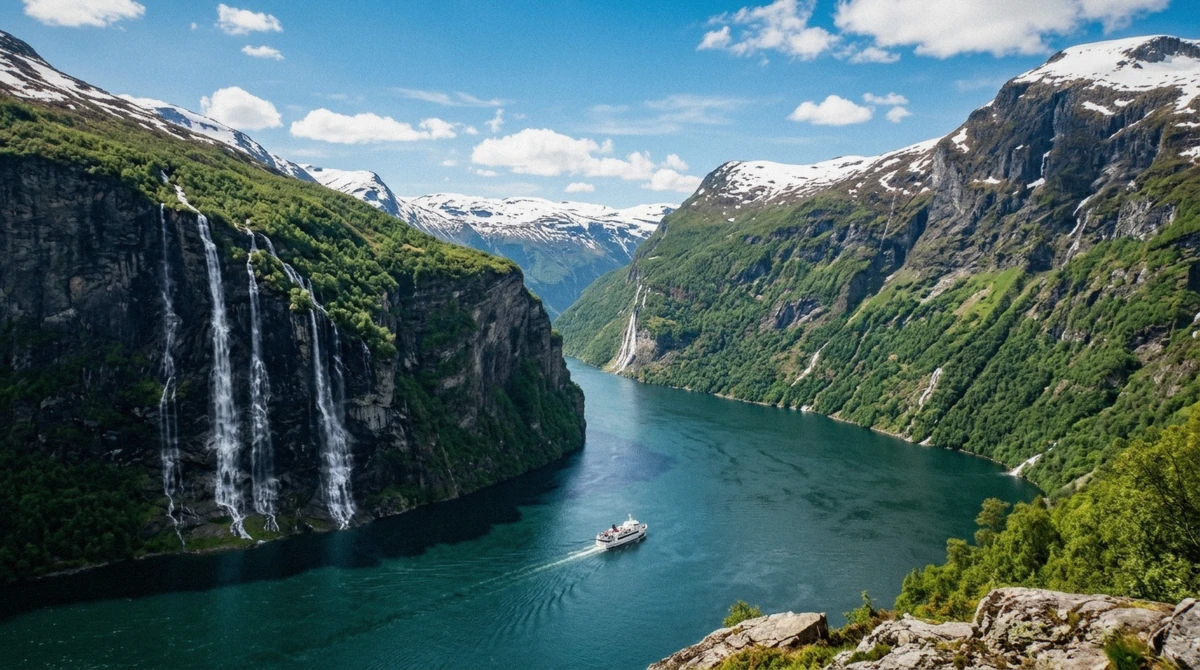
The best time to visit the Geirangerfjord is late May into early July, when snowmelt drives the Seven Sisters to peak flow and the local sightseeing fleet is running full schedules. August is the reliable runner-up, warmer but with thinner waterfalls and bigger crowds.
Key takeaways
- Best window: late May to early July, driven by snowmelt feeding the waterfalls
- Runner-up: August, warmer fjord water but a real trade-off in waterfall volume
- Avoid for boat time: the village fleet stops for the season after September, leaving the winter cruise from Ålesund as the one option
- Counterintuitive fact: June, not deep summer, is the driest month on record here
- Best time of day on any month: the first departure or after 16:00, before or after the cruise-ship rush
- Summer daytime highs reach about 18°C in July and August; the fjord water itself tops out near 14°C
Seasons at a Glance
How to read the Verdict column
The table below covers typical conditions by month, based on long-term climate averages for the Geiranger area; treat every figure as a typical range rather than a guarantee, and check the current forecast close to your dates.
| Month | Wildlife/Conditions | Weather | Crowds | Verdict |
|---|---|---|---|---|
| January | Fjord frozen-still, no local boats | Cold, short days | Low | Skip for boats |
| February | Wettest month, no local boats | Cold, wet | Low | Avoid, heaviest rain |
| March | Snowpack still building for melt | Cold, drying out | Low | Skip for boats |
| April | Meltwater starting, road opens later | Cool, driest of the cold months | Low | Quiet, still cold |
| May | Waterfalls building fast, Dalsnibba road opens | Mild, cool nights | Low to Moderate | Good, early season |
| June | Peak snowmelt, driest month overall | Warm, driest | Moderate to High | Best overall |
| July | Falls still strong, water warmest | Warmest, occasional rain | High (cruise ships) | Best overall |
| August | Falls thinning after dry spells | Warm, similar to July | High (cruise ships) | Good, more rain risk |
| September | Local fleet's last full month | Cooling, wetter | Moderate | Good value, cooler water |
| October | Village fleet winding down | Cool, rain rising | Low to Moderate | Shoulder, boats limited |
| November | No local boats, winter cruise only | Cold, very wet | Low | Avoid, wettest month |
| December | No local boats, winter cruise only | Cold, wet | Low | Skip for boats |
Temperatures and Rainfall
Figures below are typical long-term climate averages for the Geiranger area at village level, not a forecast; check the current forecast close to your travel dates.
| Month | High | Low | Rain |
|---|---|---|---|
| January | 3°C | −3°C | 174 mm |
| February | 4°C | −1°C | 254 mm |
| March | 5°C | −1°C | 128 mm |
| April | 9°C | 1°C | 65 mm |
| May | 12°C | 4°C | 90 mm |
| June | 16°C | 8°C | 59 mm |
| July | 18°C | 10°C | 105 mm |
| August | 18°C | 10°C | 79 mm |
| September | 15°C | 8°C | 136 mm |
| October | 9°C | 4°C | 185 mm |
| November | 6°C | 1°C | 249 mm |
| December | 4°C | −2°C | 213 mm |
Reading the numbers
June is the driest month at 59 mm, ahead of every other month on the table, while November and February are the wettest at 249 and 254 mm. Summer highs reach 18°C in July and August; by winter, daytime highs sit around 3 to 4°C. These are long-term climate averages for the Geiranger area, not a named forecast service, so check the current forecast close to your dates.
Best Season by Traveler Type
If Photographer chasing full waterfalls
Late May to mid-June, when snowmelt runs hardest and light stays long into the evening
If Waterfall-chaser who wants maximum volume over crowds
June, the driest month on record but still before the heaviest August dry-spell thinning
If Crowd-avoider
September, when the local fleet is still running but the cruise-ship traffic has thinned
If Budget traveler
Late September into early October, cooler but with fewer people bidding up demand
If Winter-romantic wanting snow and quiet
Any month from October to April via the winter cruise from Ålesund, the one boat still running
Spring (April to May): Waterfalls Building, Thinnest Crowds
Early season, before the rush
April brings highs around 9°C and the driest stretch of the cold months at 65 mm; by May that climbs to a milder 12°C with 90 mm of rain. Waterfalls are building through this window as snowmelt gets underway, though full flow is still a few weeks off. Crowds run low to moderate, and Dalsnibba's summit road opens in May, weather permitting.
- Daytime highs: 9°C (April) to 12°C (May)
- Crowds: low, rising through May
- Price signal: cheaper than peak summer, especially early May
- Booking lead time: short, availability is easier to find
Summer (June to August): Peak Flow, Peak Crowds
The best water, the biggest ships
June is the driest month overall at 59 mm and the start of peak snowmelt, making it the strongest single month for waterfall volume. July and August hold similar highs around 18°C with warmer, though still cool, fjord water near 14°C. This is also cruise-ship season at its heaviest, so the trade-off for the best conditions is the busiest village. A RIB fjordsafari departs close to hourly through summer, and the Ålesund round trip runs its full daily schedule in this window.
- Daytime highs: 16 to 18°C
- Crowds: high, driven by cruise-ship days
- Price signal: peak-season pricing, book ahead for the popular departure slots
- Booking lead time: several days to a week ahead in peak weeks
Autumn (September to October): Cooler Water, Better Value
The local fleet's last stretch
September holds a still-respectable 15°C by day, though rain climbs to 136 mm as the wettest month of the warm season. By October highs drop to 9°C and the village boat fleet is winding down for the year. This is the value window: fewer people, still-open boats, and noticeably easier bookings.
- Daytime highs: 9 to 15°C
- Crowds: moderate in September, thinning by October
- Price signal: softer demand than July and August
- Booking lead time: same-day or next-day availability is common
Winter (November to March): One Boat, No Crowds
The fjord without the local fleet
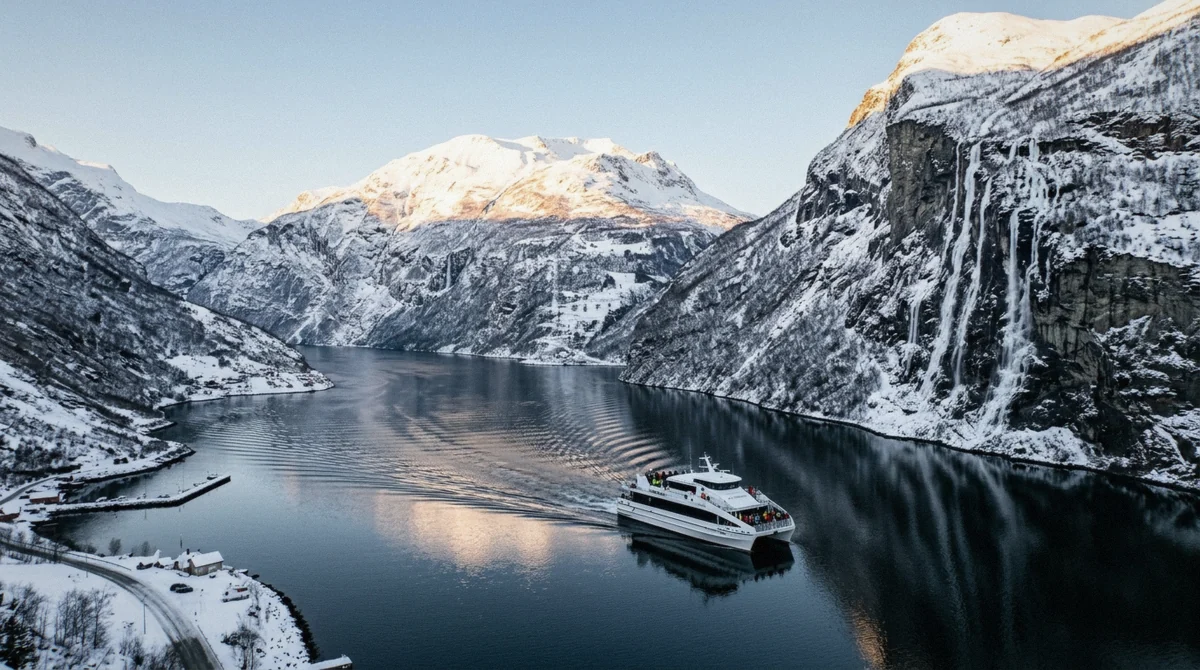
November and February are the wettest months on the table, at 249 and 254 mm, and daytime highs sit at or below freezing from December through March. The local sightseeing fleet does not run in this window; the winter cruise from Ålesund is the one option that still reaches the Geirangerfjord, running a full day with Fjord Rangers on board and a stop at the Norwegian Fjord Centre.
- Daytime highs: −3 to 6°C across the winter months
- Crowds: low, the quietest stretch of the year
- Price signal: the winter cruise runs at a fixed premium, reflecting the longer route from Ålesund
- Booking lead time: relatively flexible, departures run less frequently so plan the date early
What Actually Affects Conditions
It's snowmelt, not rainfall, that fills the falls
Most visitors assume the wettest months make the best waterfalls. It is actually the opposite mechanism: the Seven Sisters and the Suitor are fed largely by snowmelt draining off the mountains above the fjord, not by the rain falling directly into the valley. That is why June, the driest month on the rainfall table, is also one of the two strongest months for waterfall volume, the meltwater pulse simply outweighs the light summer rain.
By contrast, a dry August stretch with little melt left to feed the falls can leave the Seven Sisters running thin, closer to five visible falls than seven.
Best Time of Day
Morning-early or after the ships leave
On any month the fjord runs boats, the best hours are the first departure of the day or anything after about 16:00. Geiranger's cruise-ship rhythm pulls tenders ashore from around 08:00, with the village and first boat departures full by mid-morning, then a lull in the afternoon before quieting after 17:00. Booking the earliest sailing or a late-afternoon slot avoids most of that window; see the cruise-port day rhythm for the full hour-by-hour pattern.
Crowds and Prices Through the Year
The ship-day pattern to plan around
Cruise-ship arrivals are the single biggest crowd driver here, far more than any calendar month on its own. On a ship day, morning boat slots and the village centre fill fast; on a non-ship day the same June morning can feel nearly empty. Prices follow demand rather than a fixed calendar, running highest through the peak of July and August and softening from September onward as the local fleet's schedule starts to thin.
What If the Weather Turns?
Boats rarely cancel outright
Light rain or wind on a fjord day is normal and boats generally sail through it, especially the enclosed sightseeing catamarans; the open RIBs and kayak tour are the ones most sensitive to real wind. Every tour compared here carries free cancellation up to 24 hours before departure, so a forecast that looks rough is worth watching rather than panicking over. If your only free morning turns bad, most travelers simply shift to a different boat type or a later slot the same day rather than losing the whole visit; for exactly what actually happens if your tour is cancelled for weather, and the fuller scenario table, see our weather and cancellations guide.
So, When Should You Go?
The verdict
Late May into early July is the best window, when snowmelt keeps the Seven Sisters at full flow and the local fleet runs its complete schedule. August is the solid runner-up if your dates are fixed elsewhere, warmer water at the cost of thinner falls and bigger crowds. November through February is the month range to avoid for boat time, the wettest and coldest stretch with no local fleet running, though the winter cruise from Ålesund keeps the door open year-round for anyone locked into those dates.
If you're still weighing whether the trip is worth it in the first place, the timing question above is most of the answer. For the full range of boats across every season, the fjord cruise comparison on our homepage breaks down price and duration side by side.
Questions About the Best Time to Visit
What is the best month to visit the Geirangerfjord?
June, for the combination of peak snowmelt-driven waterfall flow and the driest weather of the year at typically 59 mm of rain.
What is the rainiest month at Geirangerfjord?
February, at a typical 254 mm, narrowly ahead of November's 249 mm. Both sit in the local fleet's off-season.
Can you visit Geirangerfjord in winter?
Yes, though the local village boat fleet does not run from around October to spring. The winter cruise from Ålesund is the one option that still reaches the fjord through the cold months, running a full day with Fjord Rangers aboard.
Is morning or afternoon better on the fjord?
The first departure of the day, before around 09:00, or anything after 16:00. Both windows sit outside the busiest cruise-ship hours.
When are boat prices lowest?
September into early October, when demand softens as the local fleet's season winds down, though the boats and waterfalls are both still in good shape.
Is September a good time to visit Geirangerfjord?
Yes. It is the local fleet's last full month of the season, with cooler daytime highs around 15°C, moderate crowds and noticeably easier bookings than July or August.
How warm is the fjord water in summer?
It tops out around 14°C even at the height of summer, cool enough that swimming is not the draw here; the appeal is the boat trip and the waterfalls themselves.